Telling Them Apart, Prominent Decorations

|
Alabama — The Clock |
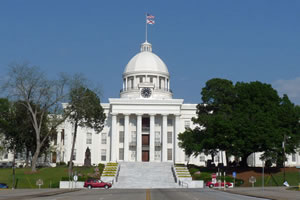
image courtesy of airnoa
through a Creative Commons Deed
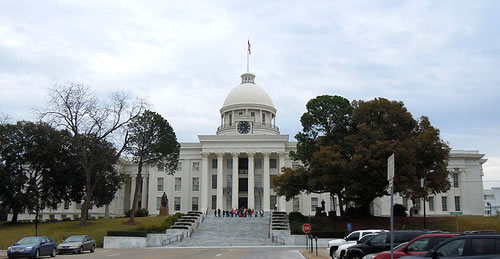
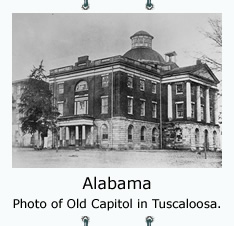
Most pictures of the Alabama state capitol building show the main, west entrance and have much of the north and south wings hidden behind the trees on the grounds. The full width of the capitol is visible through and next to the trees in the image below. |
The gleaming white Alabama capitol stands on Goat Hill, a gentle rise which provides an appropriately prominent site. The dome rises above the surroundings and can be seen in the skyline from a great distance. The main building exterior is finished in Alabama white marble, prized throughout the world by sculptors and architects.
Standing on the front of the portico roof, the clock is a very visible and memorable feature, especially with its black face against the white capitol building. Originally built as the town clock, there are faces on at least three sides, as can be seen in the image at left.
|
|
|
An Association
If you put our 50 states into alphabetical order, Alabama comes first. The prominent clock on the capitol in the state that is first in that list provides a rather vague, but memorable association. The 'first' simply becomes a time - as well as an order - thing. First in time, First in order, Alabama.
image courtesy of thebalancebeam
through
Creative Commons
|
More on Alabama:
What's On Top, Flagstaffs (on domes)
Favorites, Photographic Art
Favorites, That's A Laugh
Alabama Postcard & Image Gallery
Capital & Capitol History
Old & New Capitol Timeline
|
| |
statecapitols.tigerleaf.com
Telling Them Apart, Prominent Decorations
|
Arizona — The Filigree |
|
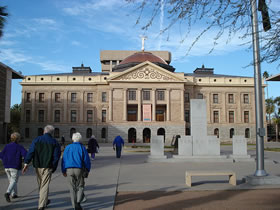
image courtesy of David Anthony Porter
The Filigree
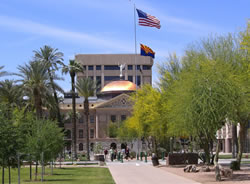
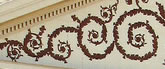
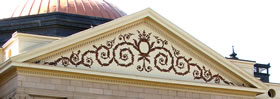
The main entrance pediment is decorated with a unique, elegant, copper filigree design.
|
|
The building pictured here is affectionately called the Arizona State Capitol, even though it is a museum now. The state legislature's quarters are in the Executive Tower, which you can see behind the copper dome of the museum.
|
Arizona Elegans
This time we have a biology lesson, of sorts, instead of a straightforward association. No one seems to know where the name, "Arizona," came from, though there are theories about towns and oak trees, but they are just theories. Most uses of the word refer to the State and are quite usual and boring. One, however, is less boring and lends itself perfectly to our association project; there is a genus of snake called Arizona elegans.
Arizona elegans is commonly known as the glossy snake. They are nocturnal and nonvenomous, and usually have spotted patterns in shades of brown.
image courtesy of the US Geological Survey
and Wikipedia
|
|
images courtesy of jimbowen
An Association
The scaly but elegant copper filigree design winding its way across the pediment certainly looks similar to the brown-on-tan, patterned glossy snake, Arizona elegans. So the capitol with the elegant snakes on the pediment is decorated with Arizona elegans - Arizona.
detail from image above
|
More on Arizona:
What's On Top, Statues of Ladies, Part 1
Arizona Postcard & Image Gallery
Capital & Capitol History
Old & New Capitol Timeline
|
| |
statecapitols.tigerleaf.com
Telling Them Apart, Prominent Decorations
|
California — The Portico Statuary |
|
Statuary
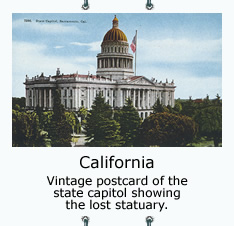
A few state capitols (KY, NJ, OK, WV) besides California's have ornaments somewhere above the ends of their front portico roofs, which means the general area where those are pictured above. As the images below show, California's are two different statues of mounted horses with a bear or a buffalo. The other states have decorative shapes (urns, standards, etc.) except Oklahoma's (griffins, I think), which are mirror images of each other. They are easily distinguished from these, even at a distance.

statuary images courtesy of
gb1k
Finally, An Association
The fictional (for our purposes) Native American poses of the statues on the portico roof and the source of the name "California" being a work of fiction make a credible, if lengthy, association. Hopefully the stories help make it memorable!
The tricky part of this association is that the statues have not always been there. They were temporarily removed during two lengthy restorations finished around 1906 and 1982. Certainly the statues will be in most images, though.
|
two images
at left
courtesy of
Andrew
A Real Bit of History
The name "California" comes from a work of fiction. A popular Spanish romance novel, "Las Sergas de Esplandián," written by Garcí Rodríguez Ordóñez de Montalvo and published in 1510, tells of an island named California where the inhabitants are all women much like the Amazons, and the beautiful queen is named Califia. The Spanish explorers surely were familiar with this story when they explored the Baja peninsula and gave it the name of California, thinking it, too, was an island, and probably dreaming of those women. Little did they know their California would be a huge territory some day.
What I Learned in School
My American History classes taught a little about the lives of the Native Americans in the northwest regions (which I admit could be in error). They were rather isolated from the rest of the continent by mountain ranges and the ocean, and never saw a horse before the European settlers arrived with them during the gold rush of 1849. Those same classes told of the buffalo (bison) that roamed the country from the Rocky Mountains east. Being west of the Rockies, the northern California Natives would not have encountered bison.
If what I learned in school of western California Indian life is true, the statues over the portico of the California capitol, a male Indian on horseback being attacked by a bear, and a female Indian also on horseback in conflict with a bison, must be depicting fiction IF (and that's a big 'if') they only represent Native Americans of the Sacramento area before 1849. I'm sure they do not, since this is a state building and not a city or county one, but for the purposes of this association we need to pretend they do. So, the statues represent fictional situations to us.
|
More on California:
What's On Top, Cupolas (on domes)
Favorites, Intriguing Interiors 2
Favorites, Nature
California Postcard & Image Gallery
Capital & Capitol History
Old & New Capitol Timeline
|
| |
statecapitols.tigerleaf.com - Telling Them Apart, Prominent Decorations
|
Kentucky — The Sculptures,
the Windows, and the Columns |
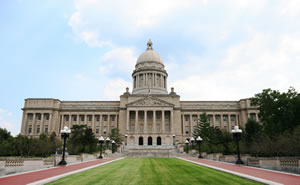
image courtesy of OZinOH
|
There are three unique, decorative features of the Kentucky capitol which all help in identifying the building. Unfortunately, they are not as prominent as other capitol decorations featured on this page. To help with this problem, we will also use the row of paired columns around the drum. They are easy to spot, so though they are not unique, they will help point us in the right direction. |
All four of our features will be linked to horses through the many images here. The horse industry does several billion dollars of business annually in the State of Kentucky. The tourism industry there does even more billions annually, and most of the tourists come because of the horses. That's why you will see so many images with horses in this section. That, and because I really like horses.
|
|

image courtesy of OZinOH
The square windows in the drum are unique to the Kentucky capitol. They resemble crossbuck stall doors or, if pictured from above, rows of box stalls.
|
Sculpture detail

detail images courtesy of
Edward Crim photographer, the State Capitols project
|
The Sculptures
The sculpted arches in the upper drum railing are unique to the Kentucky capitol. They resemble the top half of a collar horses wear when they do heavy pulling. (Also see the carriage horse image below.)
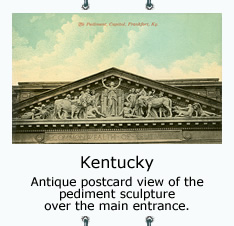
The sculptures over the ends of the entrance pediment are also unique to Kentucky. The X-shape in them resembles crossed poles or boards, common in jumps and stable doors.
|
|
The paired columns around the drum resemble the parallel inner and outer rails of a typical race track as pictured on the left, and the pair of poles at the sides of a carriage horse as pictured on the right. In both cases, one pole would not work quite right without the other.
An Association
When you see the paired drum columns (not unique to Kentucky) on a capitol, check for the other horse-related shapes in the sculptures and drum windows. If the horse link is there, it's in "The Horse Capital of the World," Kentucky.
|
More on Kentucky:
What's On Top, Cupolas (on domes) 1
Favorites, Intriguing Interiors, Kentucky
Favorites, Just Because
Kentucky Postcard & Image Gallery
Capital & Capitol History
Old & New Capitol Timeline
|
| |
Telling Them Apart, Prominent Decorations
|
Minnesota — The Golden Statue |

image courtesy of
Scott W. Coulter, Apple Valley, Minnesota
The design of the Minnesota state capitol was influenced by the heavily lit, white stucco buildings of the "White City" in the 1893 Chicago Columbian Exposition. Cass Gilbert, the architect, did not want a dark and forbidding building for this capitol. The dome and upper stories are made of white Georgia marble, and the ground floor and steps are St. Cloud granite.
An Association
The large, gilded statue over the entrance must be the "Quadriga" with a charioteer who would be a warrior or another grand man; Saint Paul was certainly a grand man; St. Paul is the capital city of Minnesota. Though Saint Paul probably never drove a chariot, it works for me! |
The Quadriga
It is high over the center of the entrance and known as "Progress of the State" or the "Quadriga." The gilded statue of four lively horses, two women holding the horses, a chariot, and a charioteer is certainly unique, and no other capitol has a gilded statue in that location. The charioteer, known as "Prosperity," is holding a horn of plenty and a banner with the state symbols. By the way, if you take a tour in good weather, you can go out on the terrace by it and see just how huge and gorgeous the statue is.
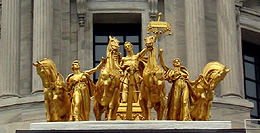
image courtesy of
Ashley Tan, United States
|
The quadriga figures are made of sheets of copper hammered around a steel frame and then gilded with 23-½ karat gold leaf. The statue was removed in 1994 for restoration and not returned until 1995, so there might be a couple of photos out there without it.
|
|
More on Minnesota:
What's On Top, Cupolas (on domes) Part 2
Minnesota Postcard & Image Gallery
Capital & Capitol History
Old & New Capitol Timeline
|
| |
Telling Them Apart, Prominent Decorations
|
North Carolina — The Honeysuckle or Crown |
|
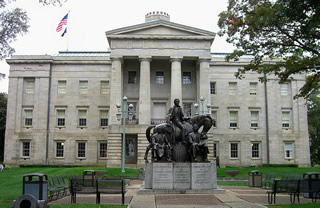
image courtesy of Dave Crosby
through Creative Commons
Design
The North Carolina state capitol building is centered in a six-acre plot called Union Square. The building is mainly constructed from North Carolina granite quarried near Raleigh. Its five-foot-diameter Doric columns and the entablature (the horizontal section that rests on top of the columns) were copied from the Parthenon in Athens.
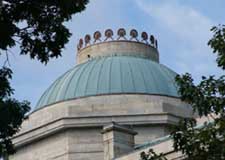
image courtesy of
Rooftop Systems Engineers, PC
|
Dome
The copper-sheathed dome of this capitol is topped with a metal ring of classic design called a "honeysuckle" or "crown." Most photos show at least part of the shallow dome and the honeysuckle. In some very old ones, the dome might be black.
|
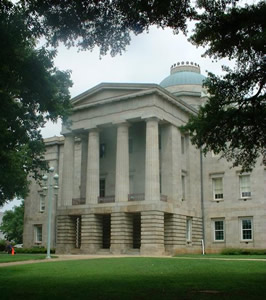
image courtesy of Charles Woodman
An Association
The first time I saw a photo of the North Carolina capitol, the unusual honeysuckle crown on the dome reminded me of an ashtray - the flat, round kind with prongs or ornaments all around it to hold the burning cigarettes. An ashtray is for cigarettes and cigars, and Raleigh is a very old brand name of a cigarette. Raleigh is also the name of North Carolina's capital city. So, the capitol with the ashtray on top is for cigarettes - Raleigh brand cigarettes - Raleigh, North Carolina.
|
More on North Carolina:
What's On Top, One of a Kind Toppers
North Carolina Postcard & Image Gallery
Capital & Capitol History
Old & New Capitol Timeline
|
| |
Return to Top
|
|