statecapitols.tigerleaf.com
Telling Them Apart, Surprisingly Different Designs

|
Alaska – |
A Basic Block
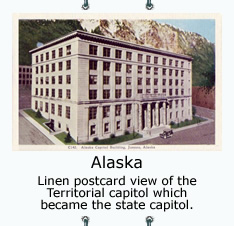
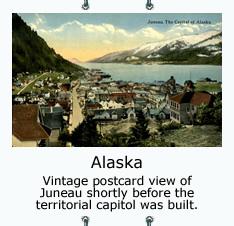
You have to wonder, why would anyone build a state capitol like Alaska's? Well, they didn't. This capitol was the Federal and Territorial Building when it was completed in 1931. When Alaska gained statehood in 1959, ownership transferred to the state and the territorial capitol became the state capitol. Many have wanted to build a grander building since then, but that has just not happened.

image courtesy of CCCPxokkeu
An Association
Alaska contains the last true wilderness in our country, and its capital, Juneau, has a population of only about 31,000. What would people from the other 49 states expect to find in Juneau and Alaska? The hustle and bustle should be less, the love of nature greater, and the people who live there would be expected to appreciate the basic necessities of life more than, say, someone in Los Angeles or New York City where abundance and over-activity are the norm. We would expect vehicles, homes, and even people to be more rugged to withstand the weather and terrain. A capitol that meets the basic necessities of the state government, has an efficient block shape with
|

image courtesy of Dave Worrell
The most ornate part of the Alaska capitol's exterior is the entrance. The rugged columns are Tokeen marble from Prince of Wales Island, and the doors are apparently brass. The setting is not fancy at all, with taller buildings as close neighbors and no landscaped grounds.
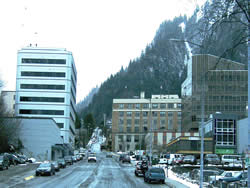
image courtesy of wellnitzt
a few rugged stone columns instead of a dome, rotunda, and portico fits that whole image better than any of our other 49 capitols. So, the basic-block capitol with the rugged columns is in the wilderness state where being basic and rugged counts - Alaska. |
More on Alaska:
What's On Top, Nothing Much
Favorites, Just Because
Favorites, Nature
Alaska Postcard & Image Gallery
Capital & Capitol History
Old & New Capitol Timeline
|
| |
statecapitols.tigerleaf.com
Telling Them Apart, Surprisingly Different Designs
|
Hawaii – |
The Pacific Island
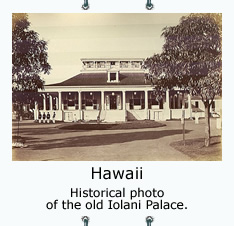
The design of Hawaii's capitol building is symbolic of a Pacific island, many of which were formed by volcanos. It is placed inside a reflecting pool, like an island surrounded by water. The columns around the circumference and elsewhere are shaped like the coconut palm trees of the islands. The roof has a symbolic crater that gives the courtyard an opening to the sky, in effect shaping the whole building like a volcano. Like many Hawaiian buildings, there are no real doorways from the outside, just open passageways leading to the courtyard where the ocean breezes can always be felt.

image courtesy of Rachel
|
|
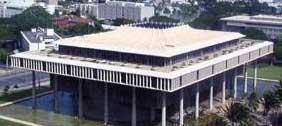
image courtesy of the State of Hawaii

image courtesy of Andrew R. Brown
Many pictures do not show the roof or the reflecting pool, but the columns are always obvious. Look especially at the top sections of the columns pictured (left) where the branches curve up and out from the trunks. Once you know they are shaped like coconut palms, the shape is easy to recognize in photographs of this capitol.
The building as a whole looks very airy and modern. The top floors sit on top of the palm tree columns, and much of the rest seems to be hung from them.
|
An Association
The palm tree columns would be a good clue except that other states have palm trees, too. The modern and airy building, however, should be easy to connect with our newest state (modern/new), our only island state (airy/island breezes), where the wonderful weather is welcomed inside.
|
More on Hawaii:
What's On Top, One of a Kind Toppers
Hawaii Postcard & Image Gallery
Capital & Capitol History
Old & New Capitol Timeline
|
| |
statecapitols.tigerleaf.com
Telling Them Apart, Surprisingly Different Designs
|
New Mexico |
– The Sun Symbol
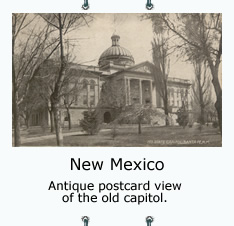
New Mexico has a round capitol building designed to honor their native Zia and Pueblo populations. This capitol, often referred to as The Roundhouse, is built like a kiva, a ceremonial chamber of the Pueblo people which is also called a roundhouse. The design is altered with four short entrance wings. This results in a structure shaped like the Zia sun symbol when viewed from above.

New Mexico capitol, arial view
image courtesy of Google Earth

Zia sun symbol on the
New Mexico State flag
|
|
|
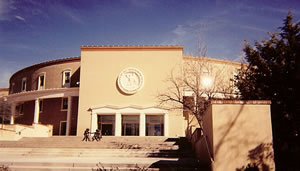
image courtesy of Ken Lund
through Creative Commons
The Sun Symbol
The Zia Indians of New Mexico regard their sun symbol, a red circle with rays pointing in four directions, as sacred. Four is a sacred number to them that is found in the four points of the compass (north, south, east, and west), the four seasons of the year (spring, summer, autumn and winter), the four periods of each day (morning, noon, evening and night), the four seasons of life (childhood, youth, middle years and old age), and the Zia's belief that with life comes four sacred obligations one must develop (a strong body, a clear mind, a pure spirit, and a devotion to the welfare of others). In the sun symbol, all of these are bound by a circle of life and love, without a beginning or end.
An Association, or Two
Connecting a round structure with the name New Mexico could be easy. It looks like a bull fighting ring, or perhaps a stack of tortillas, both of which are distinctly Mexican. But, then, other sports stadiums and a stack of pancakes are also round. Instead, connect the sacred, round sun symbol capitol to the capital city, Santa Fe, a Spanish name which means Holy Faith in English. So, the round capitol, a sacred sun symbol, is in Holy Faith, or Santa Fe, New Mexico.
|
More on New Mexico:
What's On Top, Nothing Much
Favorites, Footprints
New Mexico Postcard & Image Gallery
Capital & Capitol History
Old & New Capitol Timeline
|
| |
statecapitols.tigerleaf.com
Telling Them Apart, Surprisingly Different Designs
|
New York – |
The Mansion
In the 32 years the New York capitol was under construction, three different teams of
architects worked on the project, resulting in a blend of Italian Renaissance, French Renaissance, and Romanesque styles that is unique. The ground floor is by Thomas Fuller, the next two floors were designed and built by Leopold Eidlitz and Henry Hobson Richardson with Richardson also designing the fourth floor and roof in Victorian-modified Romanesque, and Isaac G. Perry finished building the capitol.
Besides the differences in the floor designs, the changes in design teams also created remarkable differences in the facades, as seen in the images at right. They don't seem to be all the same building.
All three design teams proposed their own plans for a domed tower that was intended to be over the current central open courtyard, but none was ever built due to the massive nature of the existing building and the problems that had already developed.
An Association
At first glance, the New York capitol looks like a grand Victorian mansion or hotel, something with lots of rooms, many of which would be sleeping quarters.
The association borrows a bit from the city of New York. Have you ever heard that New York is "The City That Never Sleeps?" Sure you have. The capitol is the mansion, with lots of sleeping quarters, but New York never sleeps. (Of course, the capitol is in Albany, not New York City.)
|
facade images courtesy of wadester16
through Creative Commons

East Side

South Side

West Side
|
More on New York:
What's On Top, One of a Kind Toppers
New York Postcard & Image Gallery
Capital & Capitol History
Old & New Capitol Timeline
|
| |
statecapitols.tigerleaf.com
Telling Them Apart, Surprisingly Different Designs
|
Oregon – |
The Fad of the 30's
Oregon's is one of five Art Deco state capitols. The other four are the towers in Louisiana, Nebraska, and North Dakota, and the former Federal and Territorial Building in Alaska. None of those four look anything like what most people expect in a capitol, but Oregon's does have a similarity to the classics in general building shape. It is horizontally oriented with a central, tall focal point over the main entrance. Other than that, it is very different; no round columns, no portico, no dome, but plenty of angles and geometric shapes instead. The drum is especially unique since it has ribs all around it but no typical windows, and it is flat-topped with no exterior dome at all.
Art Deco
Art Deco was a popular architectural style in the United States when the Oregon capitol was designed in 1935. It typically includes extensive decoration, especially in those angles and geometric shapes mentioned above. Besides our five capitols, there are many famous Art Deco buildings; The Chrysler Building, The Empire State Building, and The Waldorf-Astoria Hotel in New York, The Merchandise Mart and The Civic Opera House in Chicago, and The Paramount Theatre in Oakland, California are just a few of them. The popularity of Art Deco was affected by World War II. With everyone cutting back and contributing to the war effort, most felt it was too lavish and gaudy, and it quickly fell from public favor. That is not to say it has no appeal now. Art Deco enjoyed a resurgence in the 1960's and again in the 1980's.
|

image courtesy of thecadfiles
To connect Oregon's 1935 capitol building to the state, we jump to the century before the Art Deco fad when the country was swept up in a different fad.
The Oregon Trail
In 1836, the first covered wagons traveled the now-famous Oregon Trail with settlers on their way to the Pacific Northwest and a new life. Over the next 30 years, probably as many as 200,000 people went west in wagons and on foot on the Trail. Like the Art Deco period, this fad was also ended by a major event. The completion of the Transcontinental Railroad in 1869 made the Oregon Trail obsolete by providing faster and safer passage. Now it is traveled by wagon and horseback for educational and recreational adventure.
An Association
So, the capitol that is so uniquely an Art Deco version of our typical, classical capitols was designed in the fad of the 30's, and its home is the namesake of the famous route used in the previous century's fad of the 30's, the Oregon Trail - Oregon.
|
More on Oregon:
What's On Top, Statues of Men
Favorites, Intriguing Interiors
Favorites, Just Because
Favorites, Photographic Art
Oregon Postcard & Image Gallery
Capital & Capitol History
Old & New Capitol Timeline
|
| |
Telling Them Apart, Surprisingly Different Designs
|
Virginia – |
A Temple
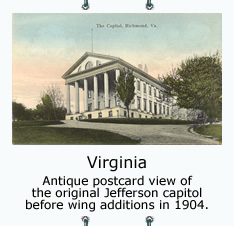
The center portion of the Virginia state capitol building was designed like an ancient Roman temple; a temple on a hill with no exterior dome, tower, or cupola. The wings on either side were added a century later.
Instead of an Association,
a History Lesson
Most Americans know who Thomas Jefferson was - the principal author of the Declaration of Independence and the third President of the United States, and he was from Virginia. A lot of Americans also probably know he was an architect. I didn't until I researched the capitol of Virginia - he designed it. Granted, it can be argued the capitol was designed by Charles-Louis Clerisseau while Jefferson was minister to France, but Jefferson also designed his Virginia home, Monticello, and he designed several of the University of Virginia buildings. Take a look at them here and you will probably never forget that Thomas Jefferson, a great Virginian, designed the 'Temple on a Hill' that is the Virginia state capitol.
|

image courtesy of Prof. Jeffery Howe
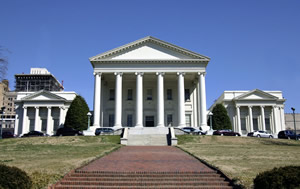
image courtesy of Prof. Jeffery Howe
|
More on Virginia:
What's On Top, Nothing Much
Favorites, Intriguing Interiors
Virginia Postcard & Image Gallery
Capital & Capitol History
Old & New Capitol Timeline
|
| |
Return to Top
|
|